
Key Points to Consider
- Verify Novelty: Before filing any patent application, it is essential to verify that the invention is novel through a thorough and well-structured patent search.
- Professional vs. DIY: While an initial self-conducted search can provide a general understanding of the prior art, engaging a professional patent searcher or patent attorney significantly improves the reliability and depth of the results.
- Global Scope: Patent searches should extend beyond national databases and include international sources to identify potential conflicts in other jurisdictions.
- Classification Systems: Effective searching requires familiarity with patent classification systems (IPC/CPC) and the use of advanced search strategies to enhance accuracy.
- FTO Awareness: A Freedom to Operate (FTO) analysis is crucial for assessing whether the commercial use of an invention may infringe on existing patent rights (note: this is distinct from a patentability search).
- Initial Tools: Publicly available databases such as the USPTO, WIPO, Espacenet, and Google Patents are useful tools for performing an initial, non-professional prior art review.
- Strategic Insight: Patent landscape studies help reveal technological trends, competitive activity, and strategic positioning within a given market.
What Is a Patent Prior Art Search?
A patent search is the process of determining whether an invention is genuinely new by reviewing existing patents and technical publications before investing significant time and financial resources in filing a patent application. Patent offices will refuse protection if they find that the same invention or a substantially similar one has already been disclosed in an earlier patent or any publicly available document.
To reduce costs, some inventors choose to conduct an initial search on their own rather than engaging a professional patent search firm or a patent attorney. While this approach may seem economical, it carries notable risks:
- Technical Complexity: Without specialized training, inventors often overlook relevant prior art. Search results are highly dependent on the choice of terminology, and non-experts frequently fail to use the most effective keywords.
- Database Limitations: Many publicly accessible patent databases are incomplete. For example, some databases do not provide full-text access to older patents (e.g., pre-1976), which can be problematic for mechanical or established domains.
For these reasons, patent professionals generally view a self-conducted search as a useful preliminary exercise only. To reliably assess novelty, it should be followed by a comprehensive analysis performed by qualified professionals.
Steps to Conduct an Effective Patent Prior Art Search:
To perform a reliable patent prior art search, follow these systematic steps:
1. Identification of Technical Keywords
Begin by brainstorming all technically relevant keywords, including synonyms and related terms. Place yourself in the position of a prior inventor: What terminology would they use?
- Tip: Avoid keywords based on "advantages" (e.g., "faster," "cheaper"). Focus strictly on the technical solution, components, mechanisms, materials, and functional relationships.
WOIPS Smart Keyword Analysis
WOIPS FeatureInstead of manually testing each keyword combination, you can run your invention through WOIPS AI-powered Novelty Search and let it automatically identify the most relevant technical terms and generate optimized search queries for you.
In the WOIPS smart platform, after entering a brief description of their idea, the user can also provide initial keywords separately.
Using AI-driven semantic analysis, WOIPS automatically evaluates the technical context and determines:
- Which keywords are highly relevant and concept-specific
- Which terms are broader or more general in nature
- Which additional related terms should be included to strengthen the search scope
The system prioritizes technically precise terms while still incorporating broader concepts to avoid missing potentially relevant prior art.
Users can review the generated keyword structure and manually adjust it promoting, removing, or modifying terms based on their strategic preference.
After the first search cycle, WOIPS analyzes the retrieved documents, identifies new relevant terminology, and refines the keyword structure automatically. The process can then be repeated to progressively improve search precision and coverage. This adaptive and interactive approach ensures both intelligent automation and full user control over the search strategy.
2. Identification of Relevant Patent Classifications
Once you find a few relevant patents, identify their classification symbols (e.g., IPC or CPC).
- Review neighboring subclasses.
- Conduct new searches based primarily on these classifications. Classification-based searches are often more reliable than keyword-only searches because they capture patents written in different languages or using obscure terminology.
More about Patent Classifications . . .
3. Construction and Optimization of Search Queries
Familiarize yourself with the syntax of the database (Boolean operators like AND, OR, NOT).
- Too many results? Refine by narrowing keywords, adding constraints, or limiting date ranges.
- Too few results? Broaden the query by adding synonyms or expanding classifications.
More about search queries ...
4. Detailed Review and Analysis
Systematically review the retrieved documents.
- Don't be discouraged: If you find a similar invention, analyze the specific technical details. Look for distinguishing features in the drawings and embodiments.
- Check Citations: Review the "citations" and "cited-by" references in relevant patents to find additional prior art.
5. Search for Non-Patent Literature (NPL)
Public disclosure anywhere in the world can affect patentability. Extend your search to:
- Scientific publications and academic papers.
- Technical standards and conference materials.
- Product manuals and websites.
Common Mistakes in Patent Searches
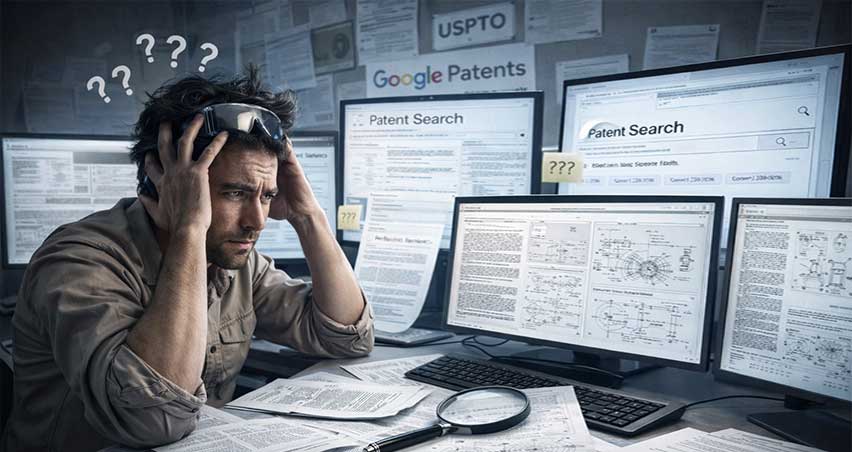
- Using Keywords that are Too Broad or Narrow: Broad terms yield too much noise; narrow terms miss critical results. Aim for a balanced set of synonyms.
- Ignoring Expired Patents: Expired patents are valid prior art. Even if a patent is no longer in force, it still proves that the technology was known.
- Overlooking Non-Patent Literature: Many solutions are disclosed in journals or manuals, not just in patent offices.
- Stopping Too Early: Finding no results immediately often means the search strategy needs adjustment, not that the invention is unique.
- Language Barriers: Failing to translate keywords into major patent languages (German, Chinese, Japanese, Korean) can result in missing highly relevant documents.
If you'd rather skip the manual process altogether, you can submit your invention for a free AI-powered prior art assessment, and WOIPS will surface the most relevant existing patents along with a similarity analysis in minutes.
Top Resources for Patent Search
- Espacenet (EPO): Provided by the European Patent Office. Access to over 100 million documents. Excellent for global searches and classification analysis.
- PATENTSCOPE (WIPO): Ideal for International (PCT) applications. Features powerful multilingual search tools.
- Google Patents: User-friendly and fast. Great for initial keyword searches and finding non-patent literature citations.
- The Lens: An open-access platform offering advanced patent analytics and citation visualization.
- Free Patents Online (FPO): Good for accessing US patents in PDF format and quick text searching.
Advanced Field Codes in PATENTSCOPE
For users utilizing WIPO's PATENTSCOPE, using "Field Codes" allows for precise targeting. Below are the most common codes:
| Code | Description | Example Query |
|---|---|---|
| FP | Front Page (Title, Abstract, etc.) | FP:("electric car") |
| IN | Inventor Name | IN:(Jobs) |
| PA | Applicant Name | PA:(Tesla) |
| IC | Int. Classification (IPC) | IC:D21 |
| CTR | Country (Origin) | CTR:(US OR DE) |
| DP | Publication Date | DP:[01.01.2020 TO 01.01.2023] |
| EN_TI | English Title | EN_TI:(Sensor) |
| CHEM | Chemical Structure | CHEM:(FormulaCode) |
Frequently Asked Questions (FAQ)
What is the difference between a professional search and a DIY search?
A professional search leverages commercial databases, multilingual strategies, and classification expertise, significantly reducing the risk of missing critical prior art compared to a personal search.
How long does a professional search take?
A basic search takes a few days, while a comprehensive analysis with a legal opinion typically requires 1 to 2 weeks.
Can I patent an idea that has been disclosed but not used?
No. Any public disclosure, even an expired or abandoned patent, constitutes prior art and can prevent the granting of a new patent for the same invention.
What is the cost of a professional search?
Costs vary by complexity and depth but typically range from $300 to $3,000.