
Introduction
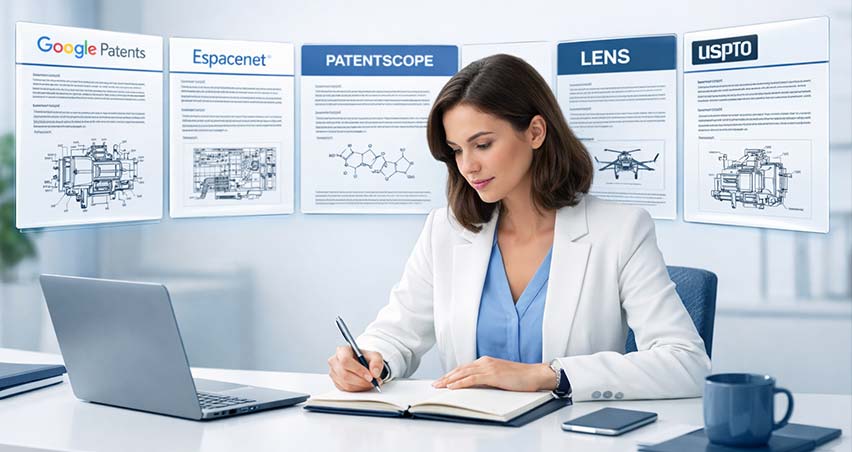
There are numerous databases available for searching patents, with most publishing nearly all patents from major patent offices worldwide. Below is an introduction to the most renowned ones, along with their respective advantages and disadvantages:
Each of these databases possesses unique features, which we will examine in detail below. Once you've identified the right database, you can refine your results further with our guide on search query engineering.
1. Google Patents
This service, provided by Google, is one of the most popular tools for conducting quick and general searches.
Advantages:
- Ease of Access: Simple, free, and features a user-friendly interface similar to the Google search engine.
- Advanced Search: Capable of full-text search.
- Automatic Translation: Offers automatic translation of documents into other languages.
- Better Links: Easily connects users to original documents or other resources.
- Free Access: Completely free to use without the need for registration.
Disadvantages:
- Lack of Access to Original PDFs: Some documents are displayed only as images.
- Lack of Access to Related Documents: Does not provide access to litigation documents or prosecution files.
- Classification Accuracy: Weaker in utilizing precise patent classification systems (such as IPC or CPC) compared to specialized databases.
- Advanced Filters: Filtering capabilities and advanced analysis features (such as precise citation analysis) are limited.
Best For:
- Quick and general searches.
- Students, researchers, and individuals seeking simpler information.
Prior Art Search for Inventions with WOIPS
WOIPS FeatureWOIPS utilizes workflow-engineered AI search system built on specialized AI retrieval pipeline, multi-stage AI search process, structured prompt-driven search workflow, semantic retrieval workflow, and custom relevance-ranking workflow to quickly, accurately, and cost-effectively identify patents and relevant technical disclosures related to your innovation.
It provides comprehensive analysis of similarities and differences, helping you better understand the surrounding prior art landscape. This report can significantly support strategic decision-making, evaluation of patentable ideas, and planning for patent filing activities. You can explore WOIPS' AI-powered patent search service to automatically cross-reference your invention across multiple major databases like these, instead of searching each one manually.
2. Espacenet (EPO)
Owned by the European Patent Office (EPO), this database is considered one of the most authoritative sources in the world.
Advantages:
- Extensive Global Coverage: Provides access to over 120 million patent documents from around the world.
- Patent Family Data: Clearly displays in which countries an invention has been filed (Patent Family).
- Legal Status Access: Provides relatively good information regarding the legal status of patents.
- Original PDF Files: Allows users to download original PDF files.
- Automatic Translation: Offers automatic translation capabilities.
- Free: Access is free of charge.
Disadvantages:
- Dated User Interface: The interface appears somewhat old-fashioned and complex, which may be confusing for beginners.
- Indexing Speed: Updating the latest patents can sometimes be time-consuming.
Best For:
- Researchers, engineers, and professionals seeking comprehensive and expert level information.
3. PATENTSCOPE (WIPO)
This database belongs to the World Intellectual Property Organization (WIPO) and focuses specifically on international patents (PCT).
Advantages:
- Focus on PCT Patents: The best source for searching inventions filed under the Patent Cooperation Treaty system.
- International Search: Allows searching across all global PCT patents.
- Original PDF Files: Users can download original PDF files and documents related to PCT procedures.
- Strong Machine Translation: Utilizes an advanced translation system with high quality.
- Linguistic Analysis: Offers search capabilities based on automatic translation.
- Free and Unrestricted: Access is completely open.
- Interface: Features both simple and advanced user interfaces.
Disadvantages:
- Limitation on National Patents: Although it has good coverage, it is not as strong as Espacenet for certain national patents (those that are not PCT).
- Filtering: Its graphical analysis and filtering tools are not as powerful as those of Lens.org.
Best For:
- Researchers, engineers, and individuals seeking international and official information.
4. LENS
Developed by Cambia, this platform is one of the most powerful tools for analyzing inventions and scientific literature.
Advantages:
- Strong Citation Analysis: The best tool for viewing which documents a patent cites (Forward Citations) and which documents cite it (Backward Citations).
- Integration of Science and Patents: Links patents to academic papers, which is highly valuable for R&D analysis.
- Beautiful Maps: Provides the ability to draw patent landscapes and competitor analysis charts graphically and aesthetically.
- Extensive Coverage: Includes all patents from the United States (USPTO), Europe (EPO), WIPO, and many others.
- Automatic Translation: Offers automatic translation into various languages.
- Multiple Filters: Allows the use of numerous filters within search results.
Disadvantages:
- Limitations in Free Version: The free version has restrictions on the number of results and downloads; professional use requires a paid subscription.
- Complexity: Due to the vast array of tools, mastering the platform takes time.
Best For:
- Researchers, engineers, and individuals seeking extensive and in-depth information.
5. USPTO (United States Patent and Trademark Office)
This is the official source for patents registered in the United States.
Advantages:
- Most Authoritative Source for the US: If you are looking for patents registered in the US market, this is the primary and most accurate source.
- Original PDF Files: Allows users to download original PDF files.
- Precise Legal Status: Provides the most accurate information regarding fee payments, expiration, and legal validity of patents in the US.
- Access to Full Images: Allows viewing and downloading high-quality images from original documents.
Disadvantages:
- Limited to the US: Focuses solely on US patents and is not suitable for global searches (unless using shared systems).
- User Interface: Its search system (East/West) is somewhat dated and technical, and may not be appealing to average users.
Best For:
- Researchers, engineers, and individuals seeking information specifically related to the United States.
Frequently Asked Questions
What is the best free database for searching global patents?
Google Patents is generally the easiest starting point for a quick, general search, thanks to its free access, full-text search, and familiar Google-style interface.
For more specialized needs, such as PCT filings or detailed citation analysis, databases like PATENTSCOPE or LENS may offer more precise results.
What is the difference between Espacenet and PATENTSCOPE?
Espacenet, maintained by the European Patent Office, offers extensive global coverage of over 120 million patent documents and detailed patent family data across many jurisdictions.
PATENTSCOPE, maintained by WIPO, focuses specifically on international applications filed under the Patent Cooperation Treaty (PCT), making it the stronger choice when the goal is researching PCT filings specifically.
Which patent database is best for citation analysis?
LENS, developed by Cambia, is generally considered the strongest tool for citation analysis, since it clearly shows which documents a patent cites and which later documents cite it back.
It also links patents to related academic papers, which can be particularly useful when researching the underlying science behind an invention.
Should I use USPTO directly if I only care about US patents?
Yes, the USPTO's own search system is the most authoritative source for information specific to the United States, including precise legal status, fee payments, and expiration dates.
Its interface is less user-friendly than newer tools, but for confirming the exact legal status of a US patent, it remains the most reliable source.
Do I need to search multiple databases, or is one enough?
Since each database has different strengths, coverage, and analysis tools, relying on just one can leave gaps in a thorough prior art search.
WOIPS' AI-powered Novelty Search cross-references multiple major databases automatically, helping reduce the risk of missing relevant prior art that a single-database search might overlook.