
The Role of Prior Art Search in Patent Drafting
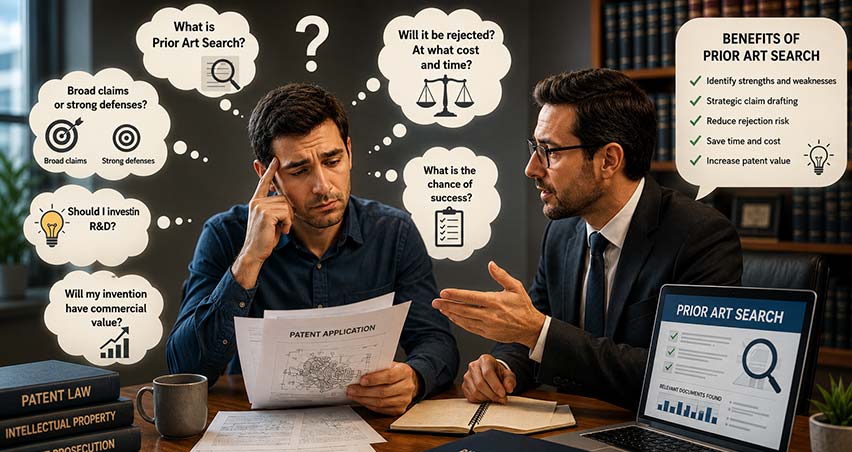
As is well known, a prior art search is conducted to identify and review previously published documents relevant to a claimed invention. This process enables patent practitioners to identify the strengths and weaknesses of a patent application during the drafting stage and to focus on aspects of the invention that have a lower level of prior disclosure. As a result, the likelihood of successful patent prosecution increases, and fewer rounds of office actions and responses are typically required in order to obtain patent protection.
Prior Art Search as a Strategic Claim Drafting Tool
In addition, a prior art search is not merely a tool for evaluating the novelty of an invention; it also plays a critical role in strategic claim drafting. In many cases, the quality of patent claims depends heavily on the drafter’s awareness of existing published disclosures and relevant patent documents.
Without an adequate search, claims may be drafted broadly without well-structured fallback positions. While broad claiming is a common strategy for maximizing protection, the absence of prior art awareness may leave the practitioner unprepared for potential novelty or inventive step objections, particularly when the dependent claims lack the precise technical limitations necessary to distinguish over unforeseen disclosures.
Why Prior Art Searches Are Sometimes Omitted
Nevertheless, in practice, patent applications are sometimes prepared and filed without conducting a comprehensive prior art search. Several reasons may contribute to this situation.
First, many inventors are not sufficiently aware of the importance of prior art searching and assume that searches performed using general-purpose or non-specialized search engines are adequate to assess the novelty of their inventions. Furthermore, some inventors believe that because they have worked in a particular industry or market for many years, they would already know if a similar technology existed.
The Hidden Risk of Undiscovered Patent Documents
However, a significant portion of patented inventions are never commercialized, despite the fact that they may still constitute highly relevant prior art capable of preventing the grant of a later patent application. In practice, only a small percentage of filed patent applications ever reach the market, yet the remaining published patent documents may still destroy novelty or inventive step for subsequent inventions.
Moreover, many patent documents cannot easily be identified through ordinary internet searches. Patent searching is far more complex than a simple keyword search. Effective patent search requires familiarity with patent classifications, claim structures, technical terminology, equivalent technical expressions, and professional search methodologies. For this reason, results obtained from general search engines are rarely sufficient substitutes for a professional prior art search.
Prior Art Search for Inventions with WOIPS
WOIPS FeatureTo help inventors and patent practitioners make more informed drafting decisions, WOIPS provides free access to AI-assisted prior art searching. By identifying relevant patent documents and technical disclosures at an early stage, users can gain valuable insight into the existing landscape before drafting claims. This allows for the development of stronger claim strategies, better-structured fallback positions, and a more focused patent specification. Having used various patent search platforms over the years, we believe that making prior art searching more accessible can significantly improve the overall quality and efficiency of patent drafting.
Budget Constraints and Practical Considerations
Another contributing factor may involve economic considerations or budget limitations. In some cases, applicants seek to minimize the initial costs associated with patent drafting and therefore choose to proceed without conducting a prior art search. Similarly, some patent practitioners may prefer to initiate the drafting and drafting process more quickly and may not consider a full search to be essential at the early stages of a project.
How Missing Prior Art Impacts Claim Drafting
However, one of the most significant consequences of omitting a prior art search is that claim drafting may no longer be performed in a strategic and targeted manner. When the patent drafter lacks sufficient awareness of the existing prior art landscape, identifying the truly distinguishing features of an invention becomes considerably more difficult. As a result, the core innovation may become obscured among already known features, while the claims focus on subject matter that has already been disclosed.
For example, suppose an inventor believes that feature “X” represents the inventive aspect of an invention. After conducting a prior art search, it may become apparent that feature “X” has already been disclosed in multiple patent documents and that the true innovation actually resides in the combination of feature “X” with feature “Y.” Under such circumstances, the claims can be strategically redrafted to focus on the genuinely novel and non-obvious aspects of the invention. Without such a search, there is a substantial risk that the original claims will ultimately be rejected during examination.
The Importance of Fallback Positions in Patent Prosecution
In addition, a prior art search enables patent practitioners to develop not only the main independent claim, but also a series of alternative claim strategies or fallback positions. This is particularly important because, during patent prosecution, portions of the original claims are often narrowed or deleted. Well-designed fallback positions can therefore play a critical role in preserving meaningful legal protection.
Prior Art Search as a Risk Management Tool
In some cases, the results of a prior art search may also lead applicants to postpone patent filing until the technology has been further developed, or even to abandon the filing process entirely. Although this may initially appear unfavorable, it can ultimately prevent substantial expenditures of time and resources on applications with limited chances of success. In reality, the purpose of a prior art search is not merely to increase the probability of obtaining a patent, but also to support informed decision-making and effective risk management throughout the patenting process.
Ultimately, the party most affected by the absence of a prior art search is the inventor. The inventor bears the filing costs, development time, and associated commercial risks. In some situations, the patent may never be granted, or the allowed claims may become so narrow that they provide little meaningful commercial value. Had the applicant possessed a clearer understanding of the prior art landscape from the outset, different decisions might have been made regarding drafting timing, technology development, or overall intellectual property strategy.
The Need for Better Prior Art Search Awareness
For this reason, inventors and companies should receive adequate education regarding the importance of prior art search so that they can make more informed decisions throughout the patenting process. Prior art searching should not be viewed merely as an additional expense, but rather as a critical tool for reducing risk, improving claim drafting quality, and increasing the real value of patent protection. The ultimate objective is not simply to file a patent application, but to obtain meaningful and enforceable protection for the developed technology.
The Growing Role of Artificial Intelligence in Patent Search
Today, the use of specialized artificial intelligence in complex and professional workflows is rapidly expanding. Unlike general-purpose AI models, patent-specific AI-based tools leverage advanced semantic search and natural language processing (NLP) models trained on global patent corpora to improve the speed, accuracy, and quality of prior art analysis.
WOIPS: An AI-Based Prior Art Search Platform
One platform developed to simplify the prior art search process is WOIPS. By leveraging AI-based patent search technologies, the platform aims to identify and analyze relevant patent documents efficiently and cost-effectively compared to many traditional search methods. Reducing the time and cost associated with prior art searching empowers inventors, startups, and small companies to conduct an effective preliminary patentability assessment, helping them evaluate the potential strength and viability of patent applications before committing substantial filing expenses or consulting a patent attorney.
Making Patent Search More Accessible to Inventors
One of the key advantages of such tools is that even users without specialized knowledge of patent databases, patent classifications, or professional search query development methods can use them relatively easily. As a result, inventors can gain a clearer baseline understanding of the technological landscape, related disclosures, and distinguishing technical features. This effectively prepares them for more productive consultations with patent professionals, enabling both inventors and their counsel to make more informed decisions regarding research and development (R&D), filing strategy, intellectual property strategy, and claim scope.
Combining Human Expertise with Artificial Intelligence
Ultimately, the combination of human expertise and artificial intelligence has the potential to significantly improve the quality of the patent filing process. Artificial intelligence should not be viewed as a replacement for the expertise and experience of patent attorneys or patent professionals. Rather, it should be regarded as a powerful tool for reducing risk, improving analytical quality, and supporting better decision-making throughout the patenting process.
Frequently Asked Questions
Can I still get a patent if I skip a prior art search before drafting?
Yes, it's technically possible to file without one, but doing so removes a key source of information that would otherwise guide how the claims are structured.
Without that information, claims are often drafted more broadly and without well-planned fallback positions, which increases the risk of rejection during examination.
Why does prior art matter even if my invention was never commercially sold by anyone else?
A large share of patented inventions are never actually brought to market, but they can still count as prior art capable of blocking a later patent, regardless of whether they were ever commercialized.
This means a keyword search focused only on marketed products or well-known brands can easily miss patents that are just as legally relevant to novelty and inventive step.
Isn't a general internet search enough to check if an idea is already patented?
Not usually. Patent searching requires familiarity with classification systems, claim structures, and technical terminology that general search engines aren't designed to handle well.
As a result, results from a standard web search are often an incomplete substitute for a proper prior art search across specialized patent databases.
What are "fallback positions," and why do they matter during patent prosecution?
Fallback positions are narrower claim variations prepared in advance, so that if a broad claim is rejected or narrowed during prosecution, a more specific version can still preserve meaningful protection.
Without prior art awareness, it's difficult to know which technical features would actually make good fallback positions, since that depends on knowing what's already been disclosed elsewhere.
How does AI-powered search change the economics of doing a prior art search early?
Traditional professional searches can be costly enough that some applicants skip them to save money early in the process, even though this often increases risk later on.
WOIPS' AI-powered Novelty Search lowers that barrier by offering a free, faster starting point, making it more practical for inventors and small teams to search before drafting instead of after running into rejections.