

Introduction
A patent document is not merely a technical text; rather, it is a combination of business, legal, and technical information that together form a valuable legal asset. Many inventors—and even some intellectual property practitioners—tend to view a patent document purely from a technical perspective. However, from the standpoint of a patent professional, a patent document is a multilayered structure in which each section serves a distinct and strategic function.
In this article, we will systematically examine:
- What categories of information a patent document contains
- The role each category plays in evaluation, strategy, and legal protection
- Which sections are particularly important in a Prior Art Search
- If a similar document is found during the search process, where the focus should be when drafting your own patent application
- Why a difference in “method,” even when reaching a “similar result,” can be sufficient for patentability
This analysis is written for those who want to think professionally about patents—not merely complete forms.
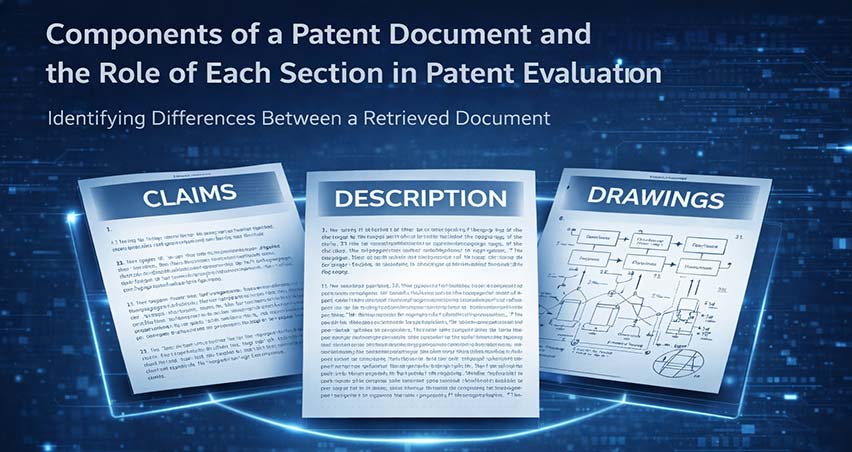
The Overall Structure of a Patent Document: Three Categories of Information
Every patent document can be divided into three primary categories of information:
- Business Information
- Legal Information
- Technical Information Together, these three categories form an enforceable legal right.
Review and Analysis of Patent documents by the WOIPS
WOIPS FeatureThe WOIPS platform examines all sections of published patent texts using trained artificial intelligence tools. If a document shows similarity to your technical solution, it saves it for you. Additionally, it offers a detailed analysis of the similarities and differences between the identified document and your technical innovations. You can try WOIPS' free AI-powered analysis on your own invention and see how it compares its structure and technical mechanism against retrieved prior art, not just the surface-level result.
1- Business Information
What does this section include?
Business information can be analyzed from both a strategic and a legal perspective. Strategically, this data reveals which company or entity is active in a particular technological field and where its focus lies within its technology portfolio. By examining filing trends over time, one can identify the trajectory of an organization’s technological investments and determine whether it is continuing to develop a specific technology or expanding into a new area. Furthermore, this information sheds light on competitors’ research and development directions and supports competitive analysis as well as informed business decision-making. From a legal standpoint, this information identifies the legal owner of the invention and clarifies who holds the right to exploit or enforce the patent. It also indicates the patent’s term and expiration date, helping determine whether the document still carries enforceable legal effect or merely serves as a technical disclosure.
In summary, business information typically appears on the front page of the patent document or in its initial sections and includes the following:
- Name of the applicant (Applicant/Assignee)
- Name of the inventor(s)
- Country and place of filing
- Filing date
- Priority date
- Publication number and patent number
- Legal status (Granted, Pending, Expired, Lapsed)
- Assignment data (information regarding transfer of ownership)
- International Patent Classifications
What is the role of this information?
From a strategic perspective:
- It shows which company is active in which technological field.
- It identifies the trajectory of an organization’s technological investments.
- It reveals the research and development direction of competitors. From a legal perspective:
- It determines who has the right to enforce or exploit the invention.
- It clarifies the duration of the patent’s validity.
- It helps determine whether the patent is still enforceable or not.
Is this section important in a Prior Art search?
For assessing novelty and inventive step, this information alone is not sufficient. However, from a practical perspective, it is highly important:
- The priority date determines whether the document was disclosed before your invention.
- The legal status indicates whether the patent is still legally enforceable or merely serves as a disclosure document.
- The applicant’s name can help identify related patent family members.
2- Legal Information
Legal information forms the legal core of every patent document and determines its scope and enforceability. This section includes the claims, the scope of protection, dependent claims, amendments made during the examination process, cited references, as well as information related to extensions or time limitations. Among these elements, the claims are considered the most important, because they precisely define what is legally protected, where the legal boundary of the invention lies, and what constitutes infringement. From an examiner’s perspective, the claims are the most decisive part of the document, since novelty and inventive step are assessed directly based on the structure and elements defined in the claims—not merely on the general explanations provided in the description.
What does it include?
- Claims
- Scope of protection
- Dependent claims
- Amendments made during prosecution
- Cited references
- Extension dates or time limitations
What is the role of the claims?
The claims determine:
- Exactly what is protected
- Where the legal boundary of the invention lies
- What constitutes infringement From an examiner’s point of view, the claims are the most important part of the document.
3- Technical Information
This section constitutes the largest portion of the patent document and includes the following:
- Title of the invention
- Field of the Invention
- Background
- Summary of the Invention
- Detailed Description
- Embodiments
- Drawings and diagrams
- Experimental data
What is the role of this section?
This section must:
- Disclose the invention in a manner that enables a person skilled in the art to carry it out
- Demonstrate the differences from the prior art
- Substantiate the technical advantages of the invention
Which section should be examined in a Prior Art search?
When reviewing a document for the purpose of assessing the novelty or inventive step of your own invention, all information contained in the description section and the corresponding drawings is important. In this context, it is generally not necessary to analyze the claims of the retrieved document, because what appears in the claims has typically already been explained in the description of the invention.
Key Professional Point
If a prior document has achieved a result similar to your invention, this alone does not mean that patentability is lost. What must be carefully examined is whether the structural elements used are identical, whether the sequence of process steps is the same, whether the technical mechanism of operation is identical, and whether the operational parameters fall within the same defined ranges. If there is a meaningful difference in any of these aspects, there may still be legal room for patent protection. In patent law, sharing the same final result does not necessarily mean that an invention lacks patentability; what is decisive is the difference in structure, the difference in method of implementation, and the difference in technical mechanism. These distinctions can form the basis for drafting independent and defensible claims.
In summary, if a prior document has achieved a result similar to your invention, but:
- The structural elements are different
- The sequence of steps is different
- The technical mechanism is different
- Or the operational parameters are different then there is likely still legal room for patent protection.
In patent law, achieving the same result does not necessarily mean a lack of patentability. What matters is:
- A difference in structure
- A difference in method
- A difference in technical mechanism
In a Prior Art search, we must clearly understand what we are evaluating and for what purpose. To assess the novelty of your claims, it is first necessary to extract the technical elements of the independent claims and analyze them element by element. Each of these elements should then be searched separately throughout all sections of the retrieved documents—not only in their claims, but also in the description, examples, and even the drawings. After that, it must be determined whether the combination of these elements, in the exact form presented in your claim, has been disclosed in a single prior document.
When assessing inventive step, the focus shifts from the mere “existence of elements” to the “obviousness of their combination.” It must be analyzed whether this combination would have been considered obvious to a person skilled in the art at the priority date. Additionally, it should be examined whether the relevant elements exist separately in different documents, and if so, whether there was any specific motivation, suggestion, or teaching to combine them. This structural analysis forms the basis of professional decision-making in patentability assessment.
In summary, what exactly should be examined in a prior art search? For assessing the novelty of your claims:
- Extract the technical elements of your independent claims.
- Search each element separately in all sections of the retrieved documents (not only in their claims).
- Then search for the combination of those elements.
For assessing inventive step:
- Determine whether the combination of elements would have been obvious to a person skilled in the art.
- Assess whether the elements exist separately in different documents.
- Examine whether there was any motivation to combine them.
If, during the search process, you encounter a document that achieves the same technical result as your invention but uses a different method or approach, this situation does not necessarily mean that patentability is lost. Rather, it requires a precise redefinition of your focus when drafting your patent application. In such circumstances, when preparing the description and claims, you should emphasize the specific technical mechanism of your solution and clearly highlight the particular sequence of process steps. It is also necessary to carefully explain any distinctive operational parameters, the different system structure, and any structural or functional distinctions. If your invention produces an unexpected technical effect, this can play a decisive role in strengthening the argument for inventive step. In essence, the focus should be on fundamental technical differences—not merely on the final result—because it is these structural and mechanistic distinctions that define the legal boundary of your invention.
In summary, what should you do if you find a document similar to your invention?
Suppose that during the search you encounter a document that:
- Achieves the same result
- But uses a different method
In this case, when drafting your own patent application, you should focus on:
- Your specific technical mechanism
- The particular sequence of steps
- Distinct operational parameters
- A different system structure
- Any unexpected technical effect
In patent law: If two inventions reach the same result, but the technical pathway to achieve it is different, this difference can serve as the basis for independent patent protection.
Therefore:
- Similarity in the final output is not necessarily problematic.
- It is similarity in structure and technical mechanism that creates difficulty.
Common Mistakes in Analyzing a Patent Document
-
Focusing solely on the title of the invention The title is often general and does not reflect the true scope of protection.
-
Focusing only on the claims of the retrieved document There may be information disclosed in the description that is not included in the claims at all.
-
Comparing the result instead of the structure Many inventors say: “This does the same thing as ours.” But the correct question is: “Does it have the same structure and the same mechanism?”
-
Ignoring the priority date It is possible that your priority date is earlier than the priority date of the retrieved invention.
Frequently Asked Questions
What are the main sections of a patent document?
A patent document is generally organized into three broad categories of information: bibliographic and business data (such as applicant, inventor, and filing dates), legal information (such as the claims and legal status), and technical information (such as the description, drawings, and background of the invention).
Each category serves a different purpose, and understanding which one to focus on depends on what you're trying to find out from the document.
Do I need to read the claims section during a prior art search?
Not always as the primary focus. The claims define the legal scope of protection, but the technical content they cover has usually already been explained, often in more detail, within the description section.
For most prior art searches, the description and drawings are typically more useful for understanding what the invention actually does and comparing it to your own.
If another patent achieves the same result as my invention, does that mean mine isn't patentable?
Not necessarily. Achieving a similar end result does not automatically eliminate patentability. What matters more is whether your invention reaches that result through a different structure, mechanism, or technical approach; a different technical path to a similar outcome can still be considered novel and non-obvious.
What's the difference between the technical information and the legal information in a patent?
Technical information describes how the invention works, what components it uses, and what problem it solves, essentially the engineering side of the document.
Legal information, on the other hand, defines the actual boundaries of protection granted by the patent, including the claims and the current legal status of the application or grant.
What's the most common mistake people make when reviewing a retrieved patent document?
One frequent mistake is focusing only on whether the final result looks similar, without examining the underlying structure or method used to achieve it.
Since patentability often hinges on structural or mechanical differences rather than surface-level similarity, WOIPS' AI-powered Novelty Search can help by systematically comparing the technical details of your invention against retrieved documents, not just their stated outcomes.